Paul Thomas Anderson's 'Phantom Thread' (2017) — nothing compares to a mother's love
Anderson's feature takes a refreshing look at the subtle power dynamics within the often clichéd relationship between an older 'genius' and his young muse

note from the projection booth: this review contains spoilers and will happily wait for your return as you watch the film (which I would recommend you do) D x
What separates the commitment of marriage and lustful craving? Just two simple words and a clear signature in some cases. For Reynolds Woodcock (Daniel Day Lewis), the two, at times, seem to have nothing in common at all. The designer’s uncomfortable reliance on his sister and near obsession with his late mother, along with a revolving door of lovers designated to a spare room in his London flat, speak of someone with an unhealthy appetite for love that doesn’t translate well into a formal agreement. Paired with a meticulous routine and tangible fear of change, Woodcock is far from the ideal husband.
Immediately it’s clear that everything he does, he does so obsessively. It’s this that seems to have earned him a devoted following in the world of couture. Woodcock sews for counts and princesses, and on an escape from the dissolution of his latest fling, a waitress named Alma (Vicky Krieps).
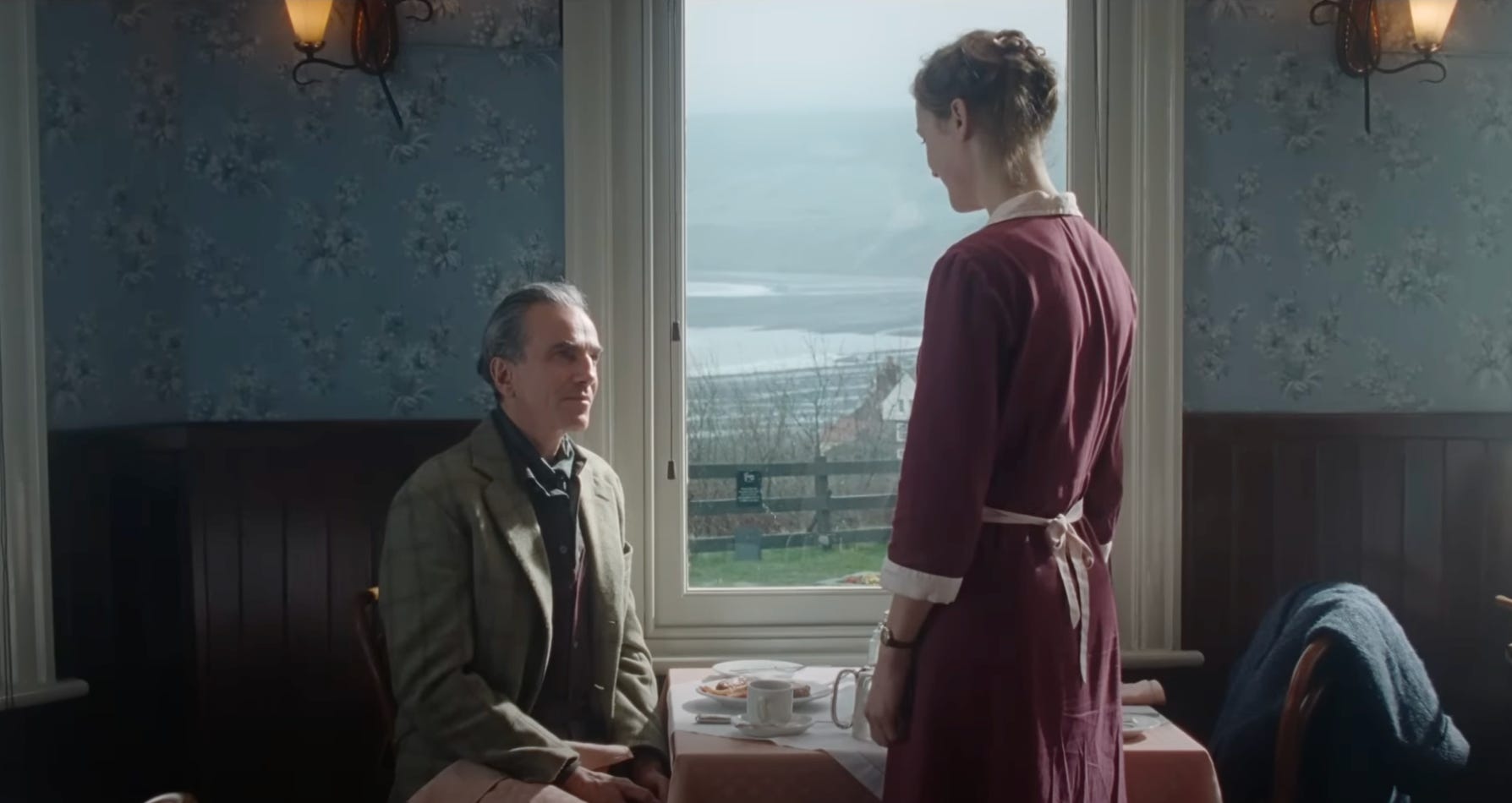
Alma and Reynolds share a stuttering first encounter that quickly transforms her into his latest lodger. Tellingly, their first date comprises of Reynolds designing her a dress, picking through the colours that would suit her, asking as an afterthought whether she likes the shade.
Soon after Alma moves in, it’s evident all is not well in their partnership. Tensions come to a head when Alma finally exiles Reynold’s sister Cyril and the townhouse staff for the evening, leaving the bustling corridors empty for a romantic dinner. Instead, she sends Reynolds into a fit of panic at the sudden change in routine. After his outburst from which there seems little hope of return for the couple, Alma seeks retribution: her earlier adventures foraging for mushrooms and scattered references to the poisonous species in a nearby woodland find purchase as she crumbles them into Reynolds’ tea.
Control is at the heart of Phantom Thread. It is control over every aspect of his life that Reynolds craves, the predictable beats of his day planned to each minute, while his sister sits happily in her own position of power as the ‘woman of the house’. Alma soon discovers her own lust for control, once the fresh excitement of a new love affair has dissipated. Reynolds’ depressive periods that follow a collection’s release, where he becomes a childlike shell of his usually authoritarian self, gives Alma a chance to dote and care for him without reprimand. Poisonous mushrooms, it seems, have a similar effect.

Luxuriating in her care, and presumably high, Reynolds dreams of his mother. Bedridden and helpless, the prospect of an eternity filled with this unsubtle parallel between a parent’s care and Alma’s fawning is too much for the couturier to resist. The second he’s recovered, Reynolds asks Alma to marry him.
Day-Lewis is a perfect fit for the autocratic designer, but perhaps more surprising is his convincing portrayal of a man who wants to give up the burdens of his reputation. For the actor’s last role, there is no better fit. His talents are put to most use in his increasingly layered relationship with Alma, as his business becomes less popular and the designer’s age puts him at a disadvantage. He is no longer a leading voice of current fashions, rather a remnant of times gone by.
Ever in control, Reynolds has been set adrift. No longer the last word in what’s in fashion, it seems his passion has departed alongside his influence. The film’s final scene has Reynolds give in to Alma’s wish for him to be weak, to be vulnerable, to be at her control, and he slowly chews down the poisoned mushroom omelette with what becomes clear is a distorted glee. “Kiss me before I’m sick,” he commands his wife. But what would once have been a controlled order becomes the plea of boy desperate for love — a craving for control that quickly became an overwhelming desire to give himself wholly over to someone else.